Categories
Fiction

Alchemist: A Guest (Part 2)

A scraggly black man with a general weary look sits across from her at the kitchen table.

She offered him coffee, or at least she waved the pot at him and he waved his mug back at her, never giving up his stream of talk. She wasn’t certain if that was what you did with a captor. Did you offer them a hot drink? It seemed polite, but he wasn’t particularly threatening, more pissed off.

It was as if he knew her, like she’d done something like this before.

He gulped the coffee like he hadn’t been fed in long while and kept calling her Kathleen, to which she found herself tilting her head like she was questioning it.

This felt different to the unexpected arrival of the card. It was still lying by the mat at the door. He had stepped over it, briskly. Did he have an air of high ranking military? But he slouched, was dirty, his boots were poorly laced. He gave the sense of having had to march, without breakfast.

Perhaps she should offer him a meal as well? She realises he’s staring at her in silence.

“Where are you Kathleen? You haven’t said a word since I got here.”

She tilts her head in reply, he pushes his chair back and stands in one swift movement; exasperated. It’s that feeling again, like he’s dealing with a difficult child. A consistent runaway, who’s forever causing him problems. Who won’t listen, who goes against orders.

Who consistently tilts her head rather than replying.

“Did you not think we’d get word? A woman hiding in the valley, her face half-burned, wandering round covering her face when she decides to speak to delivery boys. Only choosing to talk to fourteen-year-old boys strikes people as odd. Disturbing. You may not have any electric in your home, but everyone round here does.”

The woman watches him silent still. She doesn’t know his name, he walked in like she should know him, he talks to her like she should know him. He acts like he followed her, but he doesn’t seem dangerous.

He isn’t a threat.

She sips her coffee, he’s bothered by this she can tell. Her silent evaluation of him. It’s pissing him off more than whatever it is she did originally. Did she run from him? That doesn’t sit right. Was he by her at The Plaza?

He’s not who she’d been expecting. It occurs to her that she doesn’t know who she’d been expecting. That she was acting on something else, some memory like a groove in a record player, she was waiting for the needle to hit it right, for it all to sync up, to harmonize.

It hadn’t. He was still exasperated in her kitchen.

Was his name Henry? Harold? Albert? Bert? Cane?

“Kane, you look starved, I have some bread, some cheese?”

He looks back at her hungry but angry.

“Kane?”

He’s not Kane then.

He stands to attention. “I didn’t know we were reverting to last names, ma’am. “

Is that why Kathleen didn’t sit right? It wasn’t her name anyway, she had always been Kat, but he had been Harashan. He was Hara, it was sort of awkwardly falling into place like half-folded origami.

She pulled the bread and cheese from the cupboards and hoped sandwiches might make things better, bring things to light.

“Did you send me the card?”

“What card?” His face crumpled, he was no longer angry, but concerned.

She busies herself with sawing at the bread. He pulls at her shoulder, “Kat, what card?”

She finds herself with the knife at his throat, a drop of blood at the blade. He puts his hands up, and backs away finally realising he hadn’t walked into a familiar setting.

“You know me Kat.”

She continues sawing at the bread, the glance of blood now threaded through its veins.

“I’m not sure what I know.”
Categories
Fiction

Alchemist: Going Dark (Part 1)

She kneeled on the wooden floorboards staring down at the bit of paper. It was more than paper; it was smooth and crisp, textured, with a gold embossed font.

An emblem, with simple text: Alchemist.

A business card worthy of American Psycho, but lacking any way to get in touch.

She got back up off the floor and looked warily past the thick and floral curtains to the dead grass outside her beaten front-door.

It had been slipped underneath her door. No note, no messenger, no package.

Did it signal a delivery?

A warning?

She left it where she’d found it and walked back and forth across the floorboards, her feet cold, while her mind ran hot.

She’d been careful. There was no internet access here. No phone signal, she hadn’t installed a phone line. She didn’t own a mobile device. There were no electronics in this house whatsoever. Not even a microwave or toaster. She cooked with gas.

She hadn’t even latched on to some unsuspecting neighbour’s WIFI, nor snuck into their  house and borrowed some device. She had no hidden pool of electronics under her floorboards that she was itching to tap into. Although she was itching.

In her dreams, she always found herself back at The Plaza, tapping at the screen, nearly covering her tracks while everything went red-hot and burned around her.

She kept getting further, nearly finding a way, but it always ended with her waking up screaming. Remembering her face singeing.

She hadn’t hacked anything. She was off grid. There had been no slip-ups. No chatter.

There weren’t neighbours here, really. There wasn’t CCTV, not down these dirt track roads, GPS barely got you to this location, what with the valley distorting the signal.

A black-spot.

There can’t be many of those nowadays. Maybe it was a case of crossing each of them off the list.

Problem was the ‘community’, they had a hive mentality, she didn’t deal with people directly, didn’t like to show her face. This need to keep her face out of circulation, could have tipped them off. Did they talk about the woman in the valley in the deadened house, who knocked out the electricity, and doesn’t own a radio? The woman who picks up a newspaper and her groceries from a pre-decided stop-off point. Who only speaks to the fourteen-year-old delivery boy, when nothing arrives.

It hadn’t arrived yesterday, neither the newspaper nor the groceries. It had happened before, nothing new, but now it seemed suspect. She had a few things stored away in the cupboards so she hadn’t felt the need to cycle her way down into the village, and remind them.

She figured it would turn up in a few days.

She had no bank accounts. Her bank notes were rolled up under her mattress.

She’d asked for clean bills, the majority had been crisp and fresh. She used the others in a myriad of locations, handed them out to travellers in exchange for anything of use, dumped them in beggars’ bowls, to stump the trackers.

Suddenly the whole plan seemed hurried, unthought out. Would she have been safer in the city? Surrounded by technology, cloaking herself with someone else’s neural tracker. Piggybacking access, rewriting her past, redistributing chunks of information, rather than walking away from it all. Shutting it all down, going dark.

She’d needed to recover, she hadn’t the energy to keep that sort of charade up, to be that purposely clandestine. She’d gone away to hide and lick her wounds, to recalibrate, to let the information sink into place. It was a lot of data, and she’d only had three months.

Or had they given her three months?

There was a knock on the door.


Categories
Fiction

Death comes out of the closet, and steps into the flashbulbs of modern society

With the new Freedom of Information Act out came a frebranding-ripeast of previously untapped information. The most startling of which involved the governmentand their rather shady body: DDL or ‘Death, Dismemberment and Liquidation’ which have now undergone a thorough re-branding since the hiring of PR firm ‘Good Golly Miss Molly’. The newly formed Life Affirmation Unit (LAU), no longer have the rather insensitive ‘Catch and Release’ policy but rather one of R&R, which I’m assured stands for ‘Release and Relaxation’. Speaking to Death , and its personal PR representative, on the subject I got an in-depth look at how one works at such a prestigious and important department.

I sit in a café overlooking the Victorian-esque streets of London, littered with greying figures escaping the cold weather. Out of nowhere a whirl of snowflakes brings the striking figure of Death, testing out the new black cape designed for the eminence by Chanel. It strides forward with PR representative Carol, from ‘Good Golly Miss Molly’ the firm signed to the newly re-branded ‘Life Affirmation Unit’, previously known as ‘Transitional Services’, and before that DDL (‘Death, Dismemberment and Liquidation.’) Although Death assures me these are all different sections, and that it is solely assigned death duties.

We sit down to some steaming beverages on this most chilly morning. Death sips delicately on its green tea, with the recent release of Death’s details, Death’s celebrity status has allowed it to really publicise healthy living, something it assures me has always been close to its heart and was really an issue it felt strongly about and needed more public support. What better celebrity spokesperson than someone who can truly see the other side of the issue. Grim Reaper it is certainly not with such a stressful, 24-hour job, Death enjoys chilling out with a nice bottle of wine, and some DVD box sets of “whatever is current at the moment” or as Carol says, ‘The Crown’ on Netflix.

When we move onto the change in the law Carol gets positively giddy, she apparently was formally in the DDL unit but was unable to tell “even her husband” of her job title due to their ambiguity clause. Although, even now, she doesn’t go into details about her previous job description. Due to the unit’s ‘Don’t ask, don’t tell’ policy the offices had rather complicated administrative procedures, and kept friends, family and co-workers in the dark. It was a shadowy affair, and Death and Carol are in positive agreement that if the Freedom of Information Act hadn’t come about they would have been knocking down doors to bring us into this era of enlightenment and out of the dark ages. Death is highly positive about “FIA” as it fondly calls it, saying it feels it’s a really positive and important step forward for human kind “in this most United of Kingdoms.”  Carol smiles, bites her lip and then hastens to correct him, “the UK and the rest of the globe.”

Death’s introduction to society hasn’t been so happily welcomed in other nations, where they are quite insistent it align itself with some sort of deity or religious system, and are rather alarmed with its allegiance to the British Nation. Death assures me it is but a regional figurehead, and that there are thousands of Reapers working within the country at this very moment, and many more doing so abroad. It adds that every assurance has been taken so that there will be no interruption to the service LAU provides, while its involved in important meetings, “such as these,” adds Carol. An appointed substitute has been in put in place, and “we are still very much on target,” says Carol.

I have heard that the pope apparently finds fault with Death’s Charter and would really like some clarification. The only thing Carol can add to this is that her contract is of ‘20 earthly years and several years of “non-denominational” after-life, which her Union are in talks with LAU to have clarified. She hastens to add that LAU is an equal opportunity employer. This is in fact a hot topic, and I get the feeling that Death is used to such lines of questioning from its own staff, no wonder wanting to make sure they’re on the right track, when working for Death. Although their press secretary was at pains to tell me that “there is no special treatment.” The only help employees are given is a health plan; “certain problem areas are highlighted and we encourage people to follow through with their own personal action plan.”

The contracts, such as Carol’s, are purely speculative and in no way indicate her time remaining on this earth, that’s why, the press secretary adds, “we are constantly renewing contracts, or find they end early. It would be most troubling to know one’s date of death, and we keep all sensitive information such as that out of the public domain, until the act has occurred.” Death however, is not “bothered,” Carol smiles, Death’s clearly got its fingers on the pulse, if maybe a few years too late. Death states that it doesn’t get involved with earthly distinctions such as faith and that HR deals with employment.

Reaper is more interested in discussing the great leaps and bounds that have taken place in “spirit transfers.”  The transfer of souls is now down to a record 8 seconds, in keeping with government guidelines and targets. Carol tells me rather breathlessly that the whole department is putting forward plans to decrease the time taken to bare milliseconds. Death remains silent on this matter. There have been rumblings in the press from some high up officials that can’t be named that Death feels hemmed in and hampered by the sudden media glare it finds itself under, and the rather incongruous targets put forth by its department. “Each death is individual, and administration is really not its forte” it is believed to have said, reports a former aide.  Death shakes its cape when I raise these questions. It states that yes, like most celebrities it finds the media glare rather unnecessary and bewildering, but understands, or has had it put to itself that this comes with the trappings of job nowadays. The millisecond plan, though, Reaper adds is wonderful, and one it is wholeheartedly behind and doing its utmost to secure within the ten-year window it has been given. Carol chirpily pipes in: “Five years.”

“Right, I’m sure that’s far more convenient for all those on NHS waiting lists.”


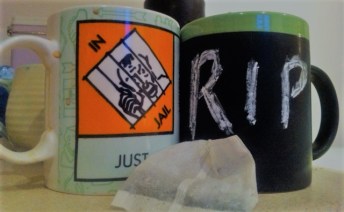
An archived piece from my idea Rebranding RIP/Transitional Services, inspired by my time working at the Probate Service.